






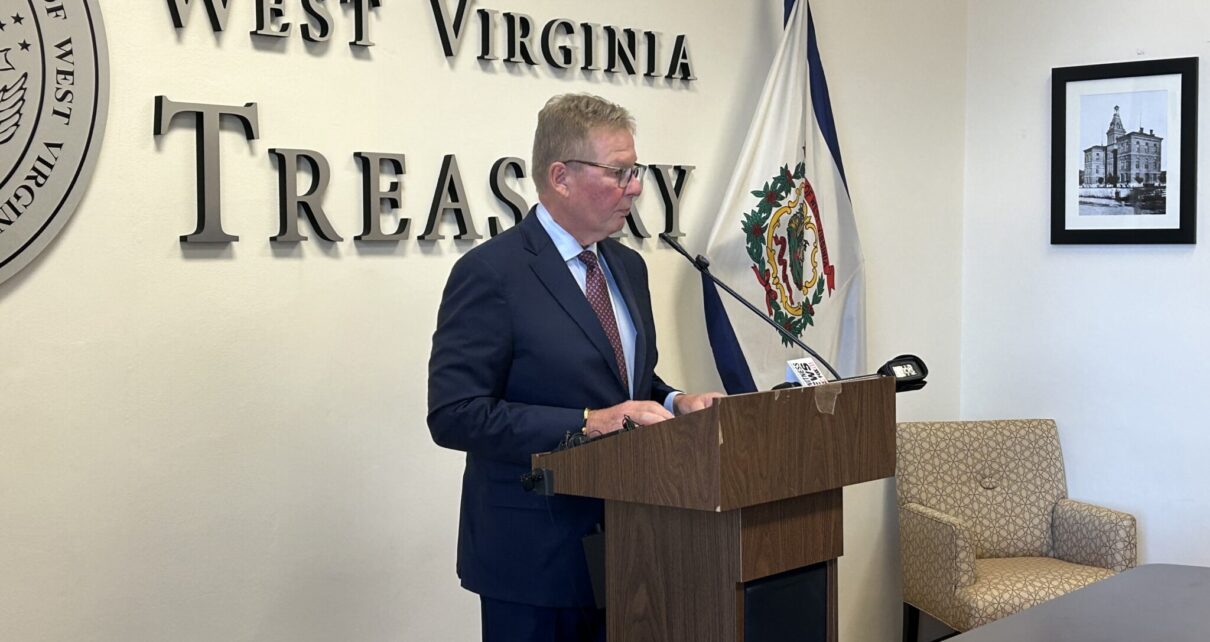
West Virginia State Treasurer Larry Pack addresses reporters about his 2026 legislative priorities during a news conference Nov. 17, 2025, in Charleston, West Virginia. (Photo by Lori Kersey/West Virginia Watch)
West Virginia State Treasurer Larry Pack defended the Hope Scholarship program Tuesday, stating that while it may contribute “a teeny bit” to declining enrollment, demographic changes are more at play in the trend.
Declining birthrates, people leaving the state and an aging population means less students entering public schools, a phenomenon Pack said began in the 1960s.
“Every school I went to is closed, so it’s not a new thing,” Pack said.
But the Hope Scholarship’s impact on this phenomenon is hard to tell, because the Treasurer’s Office doesn’t keep track of it.
Pack oversees the Hope Scholarship program, which offers families $5,400 per student in tax payer money for families to send them to private school or teach them at home. Last week, the West Virginia Department of Education announced a 3.5% decline in student enrollment, which some county superintendents attributed in part to the Hope Scholarship.
Pack said when the Treasurer’s Office accepts applications for the Hope Scholarship, it does not ask whether the student is transferring out of public school.
“We’re not supposed to ask that question,” he said. “I think we can probably put it on there as optional and see if anybody will answer it.”
Pack said he wants to work with local school officials to get better data.
On Monday, Pack’s office released the latest report on the Hope Scholarship’s performance for the 2025-26 school year, which showed nearly 15,000 students participated. He said based on those numbers, he estimates a couple thousand students may have transferred out of public schools.
Pack said the number of private school students have remained steady in the state over the last five years, as had homeschooling. He said the Hope Scholarship is only a funding source for parents and not seeing growth in either indicates it’s not the driver of declining enrollment.
Public school advocates who have placed emphasis on Hope’s hand in declining enrollments are looking for something to blame, Pack said.
“When you’re struggling, you point out other things that you think might be exacerbating the problem,” Pack said. “So I don’t take it personal. I think they’re struggling, so they’re just pointing here, pointing there, trying to figure out how to get out of this mess.”
“When you weigh $160 million for Hope Scholarship is what we think for this current year versus the $2.4 billion we spend on public schools, we’re spending a lot of money on public schools. So I don’t think Hope has a big impact on them, but it does have a teeny bit,” Pack added.
Just because Pack is a supporter of the Hope Scholarship doesn’t mean he’s anti-public school, he said.
“If you’re an elected official in public service in West Virginia, I think it’s mandatory that you’re pro public school,” he said.
Pack said with the Hope Scholarship being pretty well established in the state, he wants to see lawmakers and state officials turn their attention to working on the financial issues befalling the public school system.
“The program is working with respect to Hope Scholarship, and what I think is happening now is now we need to focus and turn (to) what is it we can do to improve our public schools?” Pack said. “I think you’re going to see that be the major thrust of the next couple years of discussions.”