








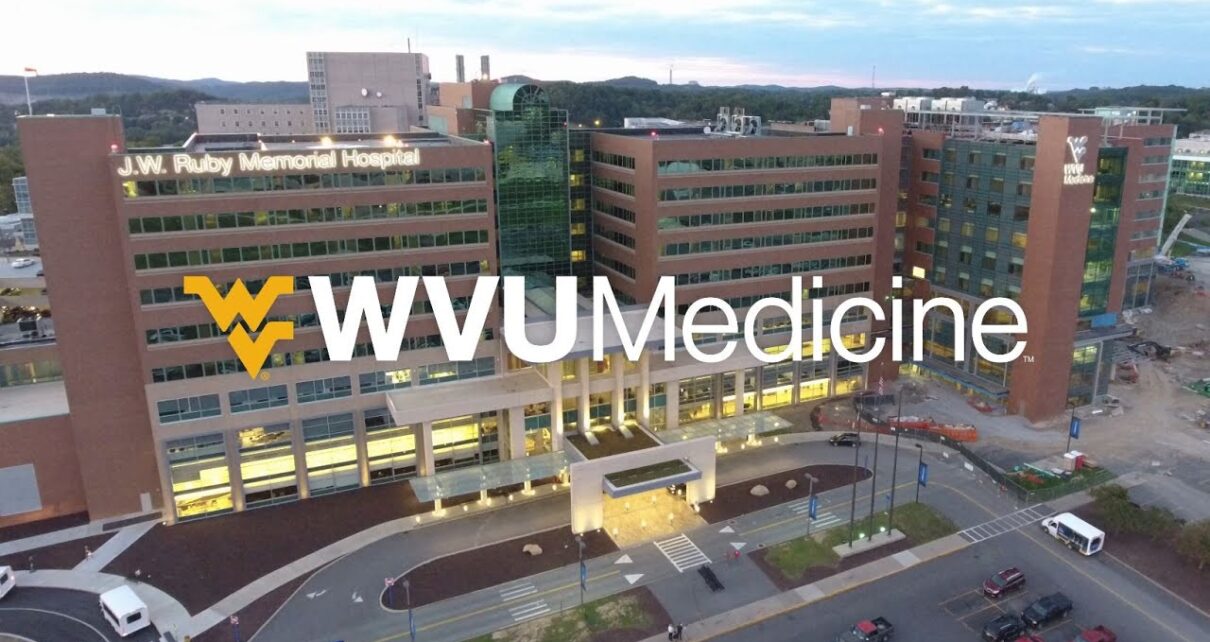
MORGANTOWN, W.Va. — A decade ago, the WVU Heart and Vascular Institute (HVI) was founded on the belief that where a person lives should never determine a person’s ability to receive the highest level of cardiovascular care. That belief continues to guide its mission today.
As an academic cardiovascular institute, the HVI was established not only to treat disease, but to advance possibilities for patients, families, and communities.
Through clinical excellence, scientific discovery, education, and collaboration, the HVI has grown into an internationally recognized destination for cardiovascular care, providing patients across West Virginia and around the world with advanced, innovative treatments.
To mark its 10th anniversary, the HVI hosted a day of events on Aug. 28, beginning with an employee celebration and capped by an evening gala at the Morgantown Marriott at Waterfront Place, which brought together members of the HVI community to reflect on the people, partnerships, and achievements that have shaped its first decade.
Building the foundation
“From the beginning, our purpose has been clear: to transform cardiovascular care by bringing together extraordinary people, innovative medicine, and a commitment to every patient with whose care we have been entrusted,” Vinay Badhwar, M.D., executive chair of the WVU Heart and Vascular Institute, said.
“The past decade has been defined by the dedication of our teams who deliver the most advanced care available through collaboration and compassion – elevating our state, institution, and university, but most importantly impacting the lives of our patients and their families.”
That vision has changed what is possible for patients across West Virginia.
“One of our goals was to make sure that no patient ever has to leave West Virginia,” Albert L. Wright, Jr., president and CEO of the West Virginia University Health System, said. “Whether that’s for preventive cardiac care or the most advanced treatment, we wanted to make sure that care was available throughout the state in a coordinated fashion.”
Soon after its founding, the HVI established programs that have changed the cardiovascular landscape in West Virginia, becoming the first in the state to offer many advanced therapies, including transcatheter mitral valve interventions, advanced robotic heart surgery, artificial mechanical heart-and-lung therapy, and heart transplantation.
“When I first joined the HVI, advanced therapies, such as heart transplantation and mechanical assist devices, were not available in West Virginia,” George Sokos, D.O., chair of the Department of Cardiology., said.
“Today, the HVI routinely offers these lifesaving treatments and has become a destination for patients with the most complex cardiovascular conditions. Being able to educate students, patients, and communities about what is now possible has been incredibly rewarding.”
A destination for care
The Institute’s growth has also made Morgantown a destination for patients seeking advanced cardiovascular care from across the country.
“HVI is now a destination for advanced healthcare,” J.W. Awori Hayanga, M.D., M.P.H., vice chair of faculty and clinical affairs, said. “We have raised the ceiling of talent and extended the boundaries of expertise to an extent that the care given here in Morgantown is at the world-class level.”
For patients, that expertise can mean more than access to advanced procedures and treatments. It can mean more time with family and the ability to return to the lives they know.
Building on an already nationally recognized robotic cardiac surgery program in 2020, HVI cardiologists and surgeons performed the first fully robotic aortic valve replacement in the world via a small incision in a patient’s right axilla (armpit).
The Institute has continued to advance the field through innovation in minimally invasive and robotic cardiac surgery, complex valve care, structural heart disease, advanced heart failure, transplantation, vascular disease, thoracic surgery, electrophysiology, and cardiovascular research.
Susan Barrett, a patient from Florida, experienced that commitment firsthand as she traveled to undergo robotic aortic valve replacement.
“I can’t say enough about the people here,” Barrett said. “I want to come back to West Virginia and this hospital for any care I may need in the future. The nurses, the recovery team, everybody made me feel cared for. They were incredible.”
Patient experiences like Barrett’s reflect the purpose behind the HVI’s growth: to expand access to advanced care while improving the lives of the people and communities it serves.
Recognized for excellence
The Institute has also received national recognition from organizations including Healthgrades and Becker’s Hospital Review for excellence in cardiovascular care.The HVI’s commitment to quality and innovation has earned national recognition, including distinguished ratings from the Society of Thoracic Surgeons, the Society for Vascular Surgery’s Vascular Quality Initiative and the Extracorporeal Life Support Organization.
The Institute has also received national recognition from organizations including Healthgrades and Becker’s Hospital Review for excellence in cardiovascular care.
Making care accessible
The HVI has focused on bringing cardiovascular expertise closer to the communities it serves while contributing to research and discoveries that influence care far beyond its borders.
Today, the HVI has expanded its reach to more than 29 locations and employs 4,000 people across West Virginia and neighboring states. Their techniques and research have global influence, as physicians from across the U.S., Europe, and Asia regularly travel to Morgantown to learn and implement HVI techniques in their own programs.
Training the next generation
As part of an academic health system, HVI’s mission extends beyond clinical care. Through education, research, mentorship, and collaboration, the Institute helps cultivate the next generation of healthcare leaders while translating discoveries into better treatments and outcomes for patients.
“Over the past decade, the WVU Heart and Vascular Institute has become a powerful example of what can be accomplished when the strengths of West Virginia University and WVU Medicine come together around a shared vision,” Michael T. Benson, WVU president and chair of the WVU Health System and WVU Hospitals boards of directors, said.
“With its work, HVI strengthens our academic mission, expands our capacity for innovation and education, and establishes WVU Medicine as a leader in heart and vascular care. We are proud of this partnership and look forward to what we can accomplish together in the next decade.”
That connection between clinical care, research, and education is central to HVI’s role as an academic cardiovascular institute.
“The seamless integration between our mission areas is really what innovation to practice to community to individual is about,” Clay B. Marsh, M.D., chancellor and executive dean for WVU Health Sciences, said. “Our goal is to create solutions that truly serve West Virginia and, in doing this, to serve the world. Impact is our focus, and the team and culture we have created is the key.”
Looking ahead
As HVI looks to the next decade, its focus is shifting beyond treating cardiovascular disease to preventing it, improving long-term health and expanding the reach of advanced care.
“While we celebrate the milestones we have reached, the true measure of our success is found in the lives changed because of this work. Every procedure performed, every discovery made, and every advancement achieved represents a patient, a family, and a future,” Dr. Badhwar said.
“We have had such a blessed last decade. But now our focus is not only on caring for the acuity of illness, but preventing it. As we look to the next 10 years, we should continue to advance and innovate as we have. We’ve done many world firsts here in West Virginia. But now we have to work on preventing the disease itself. That’s our next chapter.”
To explore the WVU Heart and Vascular Institute’s 10-year journey, learn more about its history and milestones, and watch the anniversary film, visit the 10th anniversary page.
For more information on the WVU Heart and Vascular Institute, visit WVUMedicine.org/Heart.


