






INTRODUCTION
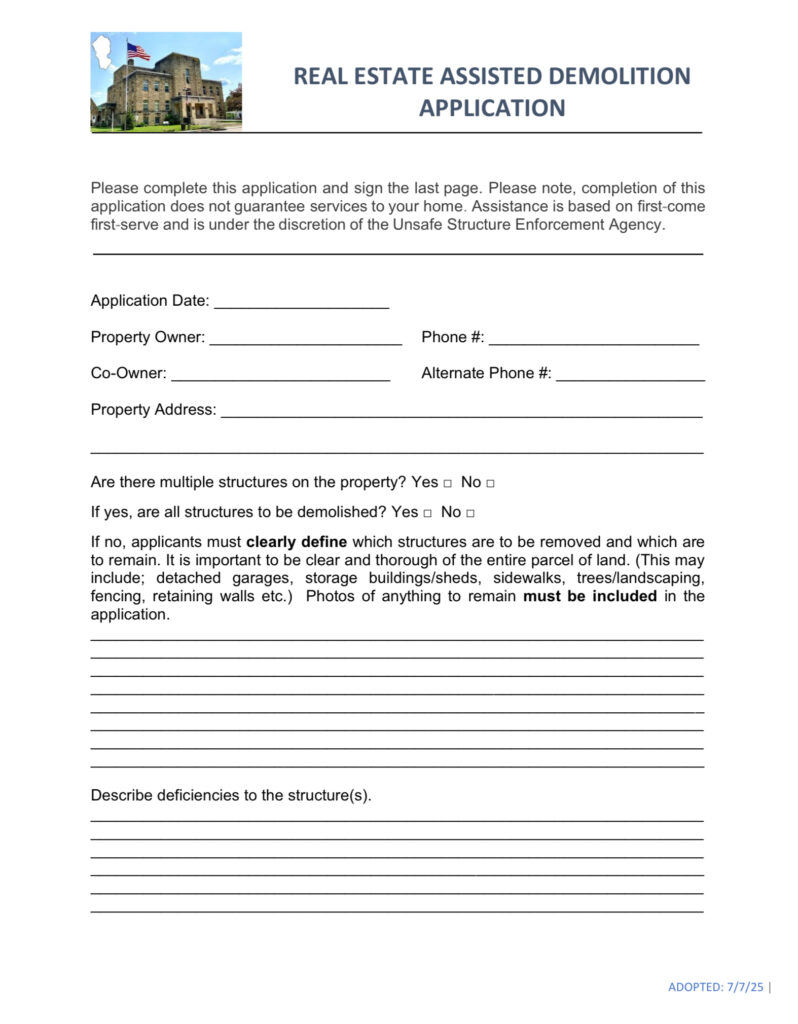
The goal of the Real Estate Assisted Demolition (RAD) Program is to assist in removing blighted structures in Calhoun County while not eliminating viable housing stock. The RAD seeks to improve the appearance, property value, and safety of residential neighborhoods within the County. This program will provide funds to assist eligible property owners with the cost(s) associated with property abatement to include, but not limited to, asbestos testing, title research, appraisal services, land clearing, structure demolition, and debris removal.
The program will provide deferred and forgivable loans for eligible expenses of qualified structures, as funding allows. Applications are processed in the order in which they are received.
PROJECT ELIGIBILITY
To qualify for, and participate in the Real Estate Assisted Demolition Program:
- A residential or commercial structure within Calhoun County (except for inside the city limits of Grantsville)
- The structure(s) must be substandard or deteriorated. The structure(s) must be functionally obsolete or economically infeasible to repair.
- Structure(s) must have been abandoned or vacant for at least a year unless posing an eminent public danger before they can be demolished under this program.
- Must be voluntary and have the owner(s) written consent. Assistance will not be provided for involuntary demolitions/condemnations, or relocation assistance.
- Applicant must have proof of ownership.
- If liens exist on the property, written consent to demolish the structure MUST be obtained prior to County Commission approval.
- All projects are subject to the National Environmental Protection Act (NEPA), including
- State Historic Preservation Office review.
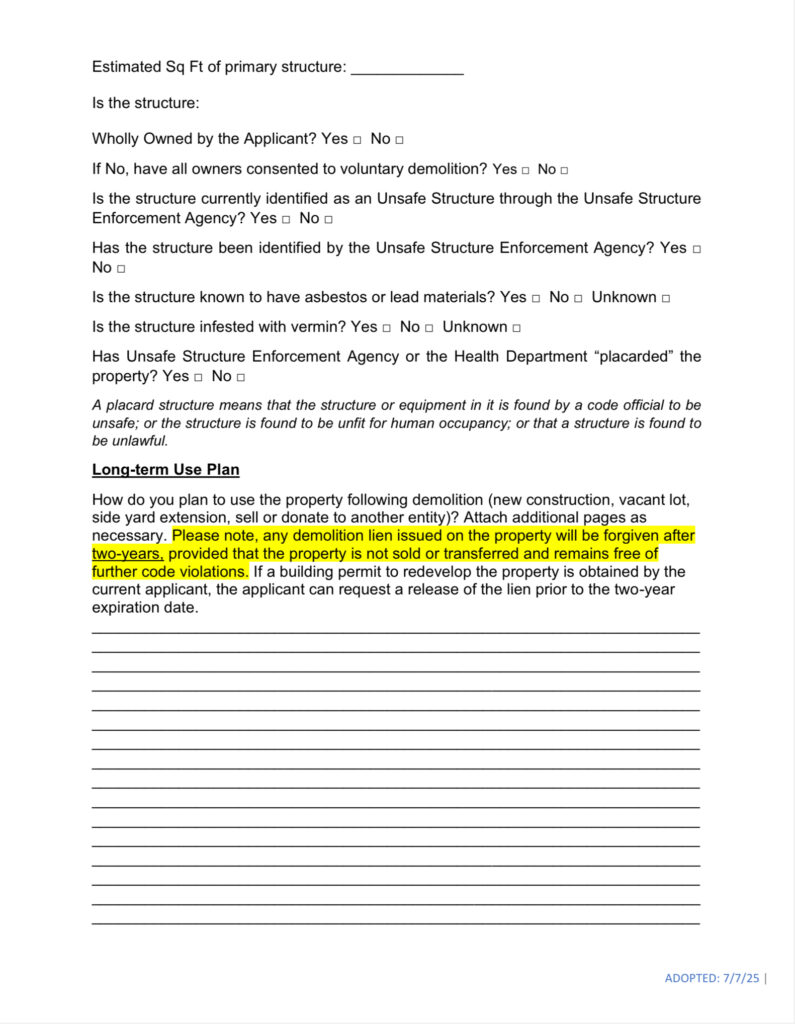
- All applications must include a long-term use plan describing how the parcel(s) will be used in the 2 years following demolition.
- County Commission has final approval of all applications received under this program.
INFEASIBLE TO REHABILITATE
All structures shall be reviewed and determined by the Unsafe Structure Enforcement Agency as not feasible to rehabilitate. To meet this criterion, the costs to rehabilitate the structure(s) must exceed $25,000. Generally, the Unsafe Structure Enforcement Agency will have identified these structures at the time of application submission, for each structure in a demolition-only project. A memo from the Unsafe Structure Enforcement Agency will determine infeasibility for rehabilitation.
PROCEDURE
The following outlines the roles and responsibilities of the applicant and the county in the application processing, procurement, and construction management stages of the project.
APPLICATION AND FUNDING PROCESS
- Application – Applications may be completed after referral from the Unsafe Structure Enforcement Agency or on the owner’s accord. Applications will be processed once all required documentation is collected.
- Project Review – The Unsafe Structure Enforcement Agency staff will use the application and related documents to determine eligibility of the project. This includes, but not limited to; granting right of entry, inspections of the property, scoring by Unsafe Structure Enforcement Agency, asbestos inspection, environmental review, verifying ownership, title search, and creating work order specifications. Photographic evidence of blighted conditions will be required.
- Applications received that have clean title may be prioritized. If liens are present on the property, Unsafe Structure Enforcement Agency staff may work with the applicant to obtain written consent to proceed with the demolition and/or release of liens from any lienholders.
- Authorization Period – The County Commission will solicit estimates/bids from qualified contractors. A contract will be drawn up by the County Commission and executed by the County, and the demolition contractor.
- All contents and debris will be discarded and removed from the property; the applicant will be responsible for removing any objects of value prior to project authorization.
- A Deed of Trust and Promissory Note will be executed between the County Commission and applicant(s) prior to contract award. At this point the applicant will be responsible to adhere to the terms of the deed of trust through the term of the program, generally 2 years.
- Demolition – Once all documentation and agreements are collected, the County Commission will issue a notice to proceed to the contractor.
DURING DEMOLITION
The Calhoun County Commission may have a qualified engineer, architect, or similar professional, independent of the construction contractor and approved by West Virginia Department of Environmental Protections (WVDEP), perform inspections during the critical phases of the project to verify that construction is proceeding in accordance with the project design and in compliance with all applicable federal and state building codes and regulations.
The Calhoun County Commission will satisfy all these provisions on behalf of the applicant.
ADOPTED: 7/7/25
Waste Disposal Requirements
The Calhoun County Commission must comply with all State and Federal waste disposal laws, when conducting demolition activities. When residential and/or commercial structures are approved for demolition, the county must ensure that the demolition wastes are properly disposed of at a permitted/licensed sanitary or demolition landfill. Specifically, the applicable DEP and EPA disposal requirements in the demolition bid and contract. This program does not cover removal of inoperable vehicles.
Davis-Bacon wage laws are not applicable to a project’s demolition activities if:
- The demolition work is not directly related to a subsequent construction project.
- Less than eight units will subsequently be constructed on the cleared site.
AFTER DEMOLITION
The Program is provided as a one-time only assistance on a property. If approved, a deferred and forgivable lien will be placed on the property in the amount of the project funding. This lien will be forgiven after two years, provided that the property is not sold or transferred and remains free of further code violations for that time. If building permit(s) are requested to redevelop the property, and if redevelopment occurs and receives a Certificate of Occupancy
(CofO) is granted, the property owner may request a release of the lien prior to the two-year expiration date. Upon completion of construction projects, Calhoun County Commission will furnish the WVDEP with the Engineer’s Certificate of Completion.
OTHER TERMS AND CONDITIONS
The Calhoun County Commission shall comply with the following programmatic requirements:
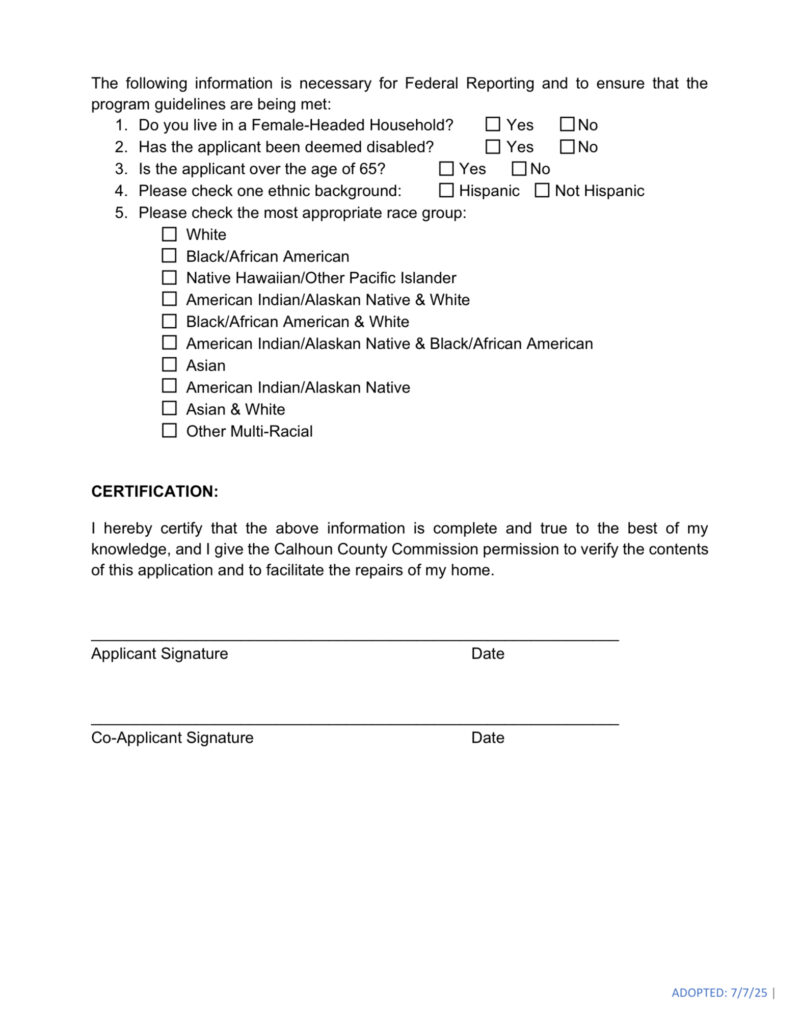
- Minority and Women Owned Businesses – The County shall attempt to solicit participation of contractors with disabilities, and female or minority owned business in accordance with Executive Orders 11625, 12138, and 12432, and OMB 2 CFR 200.
- Historic Preservation Requirements – All properties are subject to review by the State
- Historic Preservation Office, as well as any other relevant historic preservation organization.
- Debarred or Suspended Contractors – Calhoun County may not use contractors that are on the List of Parties Excluded from Federal Procurement and Non-Procurement Programs. Contractors that are on that list cannot be awarded contracts funded with federal dollars. The Consortium will check the federal website, Excluded Parties List System at https://www.sam.gov to review the current list and ensure that contracts are not awarded to debarred or suspended contractors. Calhoun County Commission shall give preference to the purchase of recycled products pursuant to guidelines outlined by the Environmental Protection Agency and listed in 40 CFR 247.